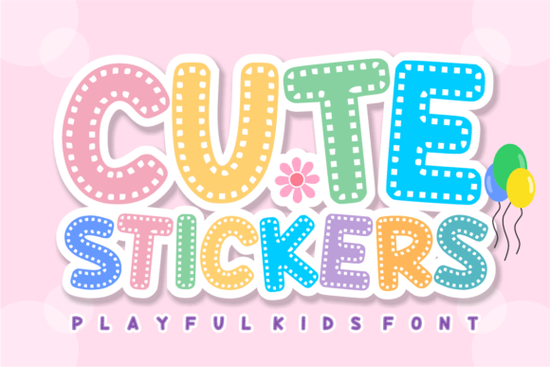
If you work with custom crafts or small-batch merchandise, you already know that playful typography often struggles with readability. The Cute Stickers Font solves that by combining bold, rounded letterforms with a clean dashed-line interior that mimics actual sewn patches. This display typeface was built specifically for makers who want high-impact fun without sacrificing legibility, making it a reliable choice for both digital layouts and physical crafting. When you pair it with solid background colors or simple vector shapes, it reads well even at smaller sizes.
Why does the stitched detail work better on physical products?
Standard kids fonts usually rely on heavy outlines or exaggerated spacing that gets lost during printing or cutting. The stitched design inside this typeface adds visual texture without relying on complex layering. When you print on planner stickers, fabric patches, or vinyl, the dashed line creates a subtle handmade effect that feels intentional. It also helps maintain strong contrast against both light and dark backgrounds, which is crucial for classroom materials and party banners where visibility matters most. Crafters consistently choose this approach because it bridges the gap between digital precision and tactile warmth.
How does it perform with cutting machines and design apps?
Compatibility matters when you are preparing files for production. This display font renders cleanly in most vector editors and raster programs, so you can trace it, adjust spacing, or convert it to paths before sending it to your cutter. The rounded edges prevent weeding nightmares, and the consistent stroke width ensures clean vinyl removal. You can install it directly on your machine, then drop it into templates for sublimation mugs, heat transfer sheets, or screen-printed tote bags. If you want to explore how other playful typefaces handle similar workflows, you might also explore a rounded typography option that handles weeding well before finalizing your layout.
- Software compatibility: Works in standard desktop publishing tools and online design platforms.
- Weeding-friendly shapes: Closed loops and smooth curves reduce material waste.
- Scalability: Holds clarity when resized for name tags or large wall decals.
What types of products actually sell with this playful style?
Small business owners and hobbyists see the best results when matching typography to the right niche. Because the stitched aesthetic naturally leans into handmade branding, it performs well on educational resources, party supplies, and kid-focused apparel. Teachers use it for flashcards and reading charts, while craft sellers apply it to custom birthday decor and vinyl labels. The bold structure also translates well to embroidered patches and sublimated tumblers, where clear spacing prevents ink bleed. When building a cohesive shop collection, you can easily mix it with other playful styles. You might check out a school-themed typeface that pairs smoothly for educational bundles, while trying a softer lettering style to balance the visual weight for younger demographics.
How do you pair it with other display typefaces?
Layering typography requires contrast. If the primary headline uses the stitched style, pair it with a clean sans-serif or a structured slab for body text. Avoid stacking two highly decorative fonts together, as that creates visual noise and hurts readability. For vintage-inspired school merch, you can incorporate a retro athletic style without competing for attention. Similarly, if your design leans into energetic cartoon themes, you can add an energetic cartoon accent to your supporting text rather than using it for main headings.
What steps should I follow before sending files to production?
Proper preparation saves time and prevents costly reprints. Always convert your text to outlines or paths before exporting. Check spacing manually, since display typefaces sometimes shift kerning when scaled. Print a test sheet at actual size to verify readability under natural light, especially for classroom handouts. When cutting vinyl, increase the blade pressure slightly for intricate dashed lines, but avoid overcutting the backing. For digital stickers, export at 300 DPI with transparent backgrounds to maintain crisp edges on both light and dark modes. You can always reference the official Cute Stickers listing for additional technical specs or licensing updates.
Quick checklist before launching your next batch
- Convert all text layers to paths before exporting final files.
- Test cut a small sample to verify blade pressure on the dashed lines.
- Check contrast against your chosen background colors at actual print size.
- Keep secondary typography simple and well-spaced to support the main headline.
- Review commercial licensing terms before applying the font to client merchandise or print-on-demand uploads.
Start with a single product line, like custom planner stickers or name tags, to gauge customer response. Once you confirm the layout works at production scale, expand into matching party favors or classroom bundles. Consistent testing and clean file preparation will keep your crafting process smooth and your designs ready for market.
Get Started Fonts for Capturing Classroom Memories
 Crayons Fonts for Creative Design Projects
 Vintage Varsity Font: Design Ideas & Creative Uses
 Free Fonts for User-Friendly Web Projects
 Get Creative with Comic Pop Font Projects
 Crafting Delight with Sweetie Pop Font